

CALLING FORTH COURAGE — MOVEMENT 3 — FREE THE FEELINGS
Oct 04, 2026Wave
On feelings as energy in motion — and what it costs to hold a wave down.

Prefer to listen? A short audio companion to this essay is right here.
The Wave
I was flying home when I understood it.
Outside the window: clouds — white, gray, billowy, solid. All of it moving. And behind all of it, holding all of it without ever changing, the sky. Blue, still, unbothered by any single cloud passing through. The sky doesn't reject the storm cloud or cling to the calm one. It doesn't come or go, cry or laugh, attach or detach. It's simply there — the space every cloud is allowed to move through.
They are not facts, and they are not who we are. They're weather, passing through something vast enough to hold them.
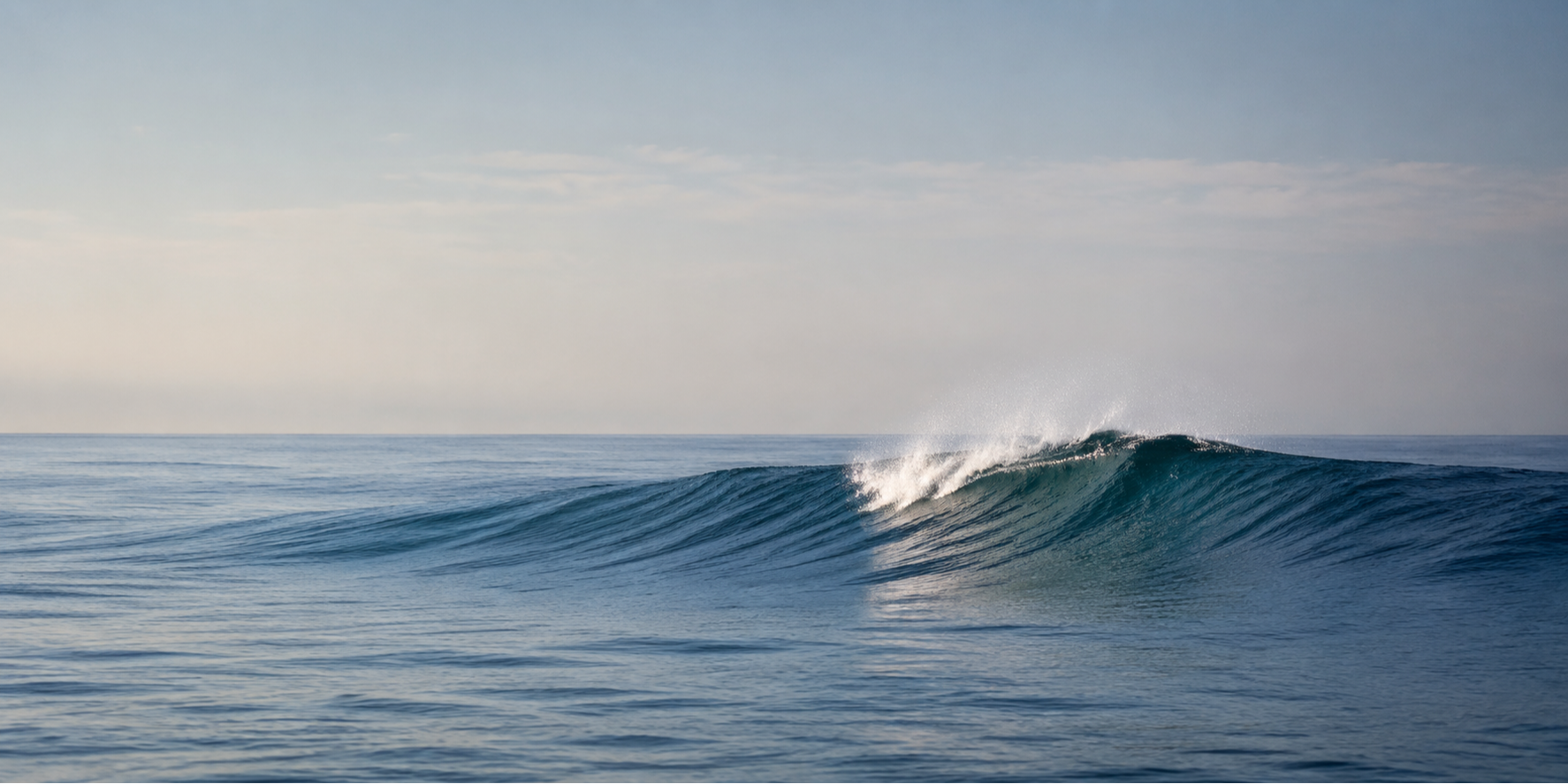
That's the whole of this movement, really. Feelings are energy in motion — e-motion. Like ocean waves, they build, they crest, they flow, and they dissolve. They cannot hurt you. They only hurt when you try to stop them.
I wish I'd known how to live that a few weeks earlier, in a casita in Bacalar, when my phone rang and everything I thought I'd already practiced got tested at once.
The Call
I'd gone to Bacalar to reflect and recharge after time with my Aunt Ginny, who is living through the stages of Alzheimer's — a season that had already asked everything of my courage. Four days in, at 8:30 at night, I got a call from Kiva's caregiver, Grant. They were on the way to the animal emergency hospital. She died on the way.
There had been no warning. She was fine Thursday, playing with her pack. Friday morning she was normal — ate, played, followed Grant everywhere. By afternoon something had shifted. She wandered off to rest in a kennel she almost never used, and when Grant called her, she didn't come. He found her awake, eyes open, breathing shallow. He carried her to the jeep. Her last breath came ten minutes later, two miles from the hospital.
I was alone when I got the news. All I could do was wail and cry and wail and cry. I didn't know what to do. I didn't want to stay in Mexico, and I didn't want to go home. It was another notch in the clearing away of my life as I've known it.
The Credit Account
Here's what I notice now, looking back. For the last couple of years I've been practicing keeping my heart open to feelings as they come and go — inviting them instead of reaching for ice cream or a cookie or whatever else might alter my state. I thought I'd finally figured something out. I thought if I let the small feelings move through — if I cried three times a month for five or ten minutes — I could accumulate a kind of credit account. Enough deposits, and when the big losses came, I wouldn't have to crumble.
I didn't realize I was bargaining. I was still trying to hold the wave down. Just with a gentler hand.
The Beach Ball
There's an image I keep coming back to: a beach ball held underwater. It doesn't matter how carefully you're holding it, or how good your reasons are, or how much you've already let go of this month. The moment the pressure releases — even a little — it explodes to the surface. That's what blocked feelings do. Not because we did the practice wrong, but because feelings were never meant to be managed into a schedule. They were meant to move.
When Kiva died, there was no credit account big enough. There was only the floor of the casita, and the sound I made, and no audience to perform composure for. Just the wave, doing what waves do — arriving in full, and eventually, releasing me.
Kiva isn't the only loss reshaping me this year - the losses arrive in different shapes, but the water is the same.
Mark Nepo writes that the things we love most deeply shape us permanently — there's no need to hold on, because they've already done their work. Already become part of the water I'm made of. I think that's true of Kiva. I think it's true of everything in me that grief has ever touched.
— Mark Nepo, The Book of Awakening
Days later I walked alone into a very empty, very silent house, where I saw her everywhere. I knew what was coming. I fell to my knees again, and I let the sadness have its way with me. Not because I mastered anything. Because I finally stopped believing I could get ahead of it.
What It Costs to Love
People have told me for years — you do hard things, you're courageous, you're strong. I understand why they say it, but it's never quite landed. I don't feel strong right now. I feel like someone who chose to love whole-heartedly, and is paying the only price that love has ever asked. That's not weakness, and it isn't strength either. It's just what it costs to keep your heart open in a world where everything we love eventually leaves.
Joy is not the absence of pain. We're given moments of joy even in the hardest seasons of our lives — but only if we let the feelings move. Hold the wave down, and you hold everything else down with it, including the joy on the other side.
Mark Nepo says it even more plainly than I have: the cries of ecstasy and agony often sound the same. I believe him. Some weeks I can't tell my own voice apart.
— Mark Nepo, The Book of Awakening
Once feelings are finally allowed to move through, something else arrives to meet them — the mind, with its opinions about how long this should take, and whether you're doing grief correctly, and what people will think. That's the next movement. But first, always first: let the wave come. Let it go. It cannot hurt you. It only hurts when you try to stop it.
Closing
I don't have three steps for this one. Grief doesn't organize itself into steps. But if there's a practice at all, it's this: the next time you feel a wave building — in your chest, your throat, behind your eyes — try not reaching for the thing that would make it stop. Not the cookie, not the scrolling, not the reason it's not that big a deal. Just let it come. It cannot hurt you. It only hurts when you try to stop it.
Where in my life am I still trying to hold a wave down?
That's the only question I have for you tonight. I don't have an answer for you either. I'm still finding mine. If you'd like to sit with this again in your own ears rather than mine — the audio is above. Or pass it along to someone who's holding a wave down right now. This is Movement 3. Let the wave come. Let it go.
If something in this is stirring — that's the beginning. You don't have to hold it down alone.
Listen to Movement 3 Audio