
CALLING FORTH COURAGE — MOVEMENT 2 — LISTEN TO THE LONGINGS
Aug 05, 2026Nineteen Stops
On the difference between what we want and what we long for — and the courage that was already there.
Prefer to listen?A short audio companion to this essay — my own CourageLine, in my own voice — is right here.
THE COURAGELINE
I did something today I've been telling others to do for months.
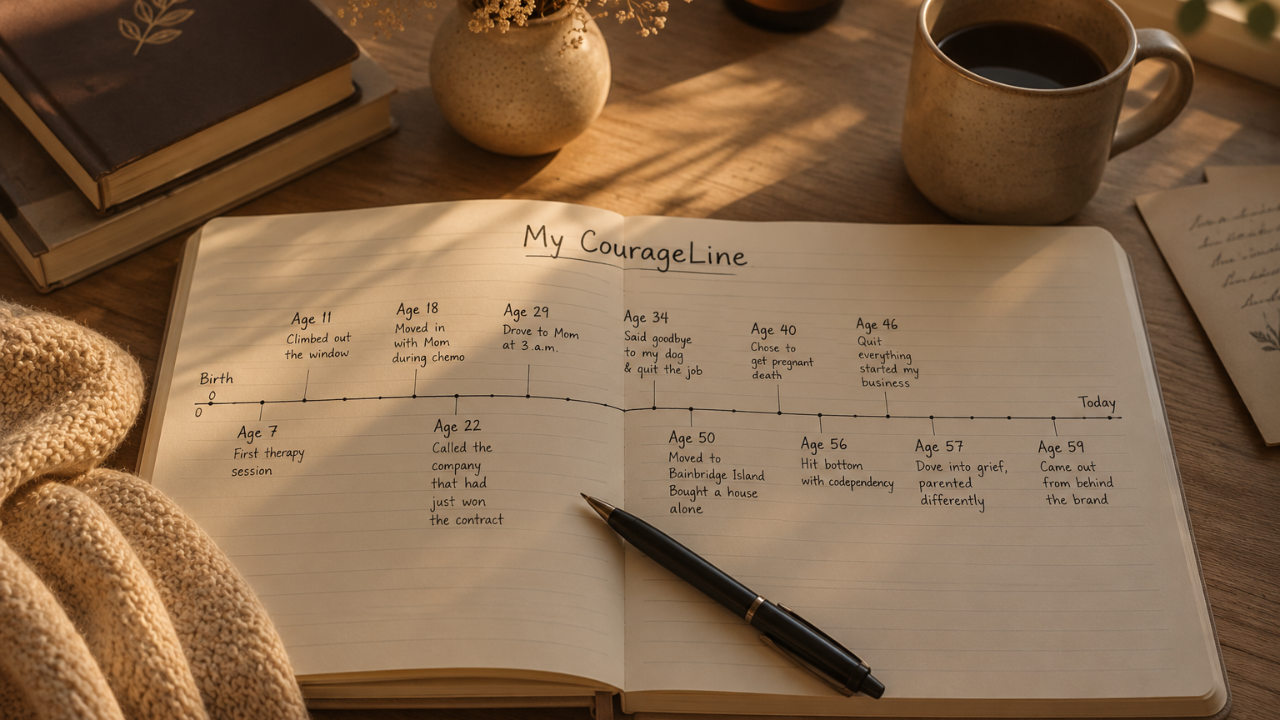
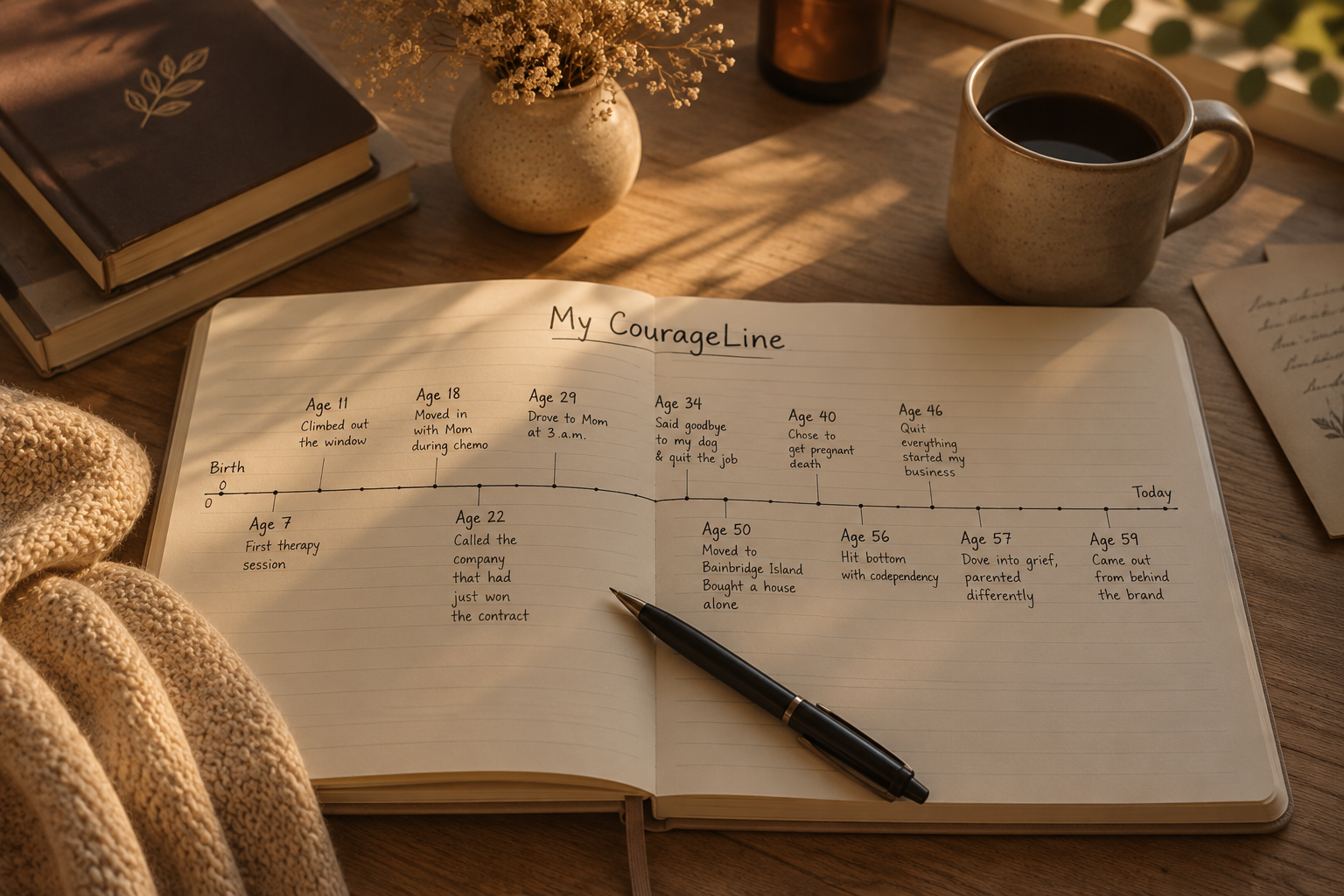
Not a metaphor. An actual line, drawn across a page. Birth on the left. Today on the right. And in between — every moment I could remember where courage was required. Not the moments that looked impressive from the outside. The moments that cost something on the inside.
I sat with a pen for longer than I expected. And they came. Slowly at first, and then all at once, the way memory does when you finally give it permission. By the time I put the pen down, I had nineteen stops. Age seven to fifty-nine. A whole life, measured not in graduations or job titles or the things you'd put on a resume, but in the moments I almost didn't do the thing — and did it anyway.
I have spent so much of my life measuring against the outside of things — job titles, milestones, what looks impressive from a distance. This line asked a different question. Not what did you achieve. What did it cost you to become who you are.
Desire vs. Longing
Here is what I had to sit with before I could even draw that line — a harder question than the one I expected.
What do I actually want?
Not the surface answer. Not the version that fits neatly into a sentence — a new client, a finished project, a good night's sleep. Those are desires. Desires are specific. Desires are achievable. Desires live close to the surface, and there is nothing wrong with them, but they are not what moves us.
Longings live deeper. A longing isn't about what you want to have. It's about what you want to feel, what you want to be. On a forest walk in January, when I asked to know courage and asked to be fully open, what came back wasn't a to-do list. It was longing, plain and unfiltered: rest. Peace. The freedom to blow where the wind takes me. Partnership and community. To laugh deliriously. To be used for something that matters. Freedom from carrying responsibility for people who were never mine to carry.
Those longings had been there the whole time. I just hadn't been quiet enough to hear them.
The Line Itself
So I drew the line. And here is what nineteen stops taught me, in no particular order and without much editing, because the CourageLine doesn't ask you to make sense of your life. It only asks you to remember it.
Age seven, walking into a child therapist's office for the third session, when the first two had felt like nothing but a room full of silence.
Age eleven, climbing out a window because staying inside was no longer survivable.
Age eighteen, moving in with my mother during chemo, when everyone my age was moving toward independence and I was moving toward her.
Age twenty-two, picking up the phone to call a company that had just won a contract, while they were still celebrating — because the alternative was staying quiet and letting it go.
Age twenty-nine, driving to my mother at three in the morning. Cradling her as she took her last breath.
Age thirty-four, taking my golden retriever to be put to sleep, and — the very same year — quitting a president's job the day I could no longer square it with my values.
Age forty, choosing to get pregnant. Trusting my husband John completely, and being terrified the entire time.
Age forty-five, John's death.
Age forty-six, quitting everything and starting my own business. A December in Mexico. A porch. The moment I first believed I might actually be able to do this.
Age fifty, moving to Bainbridge Island. Buying a house alone, against my family's wishes.
Age fifty-six, hitting the bottom of a codependency I'd built my whole identity around.
Age fifty-seven, diving into grief after my son Matthew's departure — and, that same year, deciding to parent differently. Surrendering the illusion of control I'd been gripping so tightly. Driving my daughter Kaya to rehab in California.
Age fifty-nine, coming out from behind a brand I'd built to be safe — a learning and development company, professional and impersonal — and returning, fully unfiltered and finally aligned, to simply Kathy Clifford and Truth in Leadership. The name I'd actually started with, thirteen years earlier. It wasn't a rebrand. It was me, all along, deciding to stop hiding behind the version of myself that felt easier to sell.
That same year, a quieter version of the same courage. Creating an online dating profile. Putting an honest photo and a few unguarded sentences about who I actually am out into the world, with no editing and no armor, and letting myself be seen by total strangers without knowing if anyone would want what they saw. Different room, same threshold. Stepping out of hiding, out of self-protection, into being visible on purpose.
Nineteen stops. And when I finally sat back and looked at the whole line, one thing was unmistakable: I have never once waited until I felt ready.
The Practice
So the second movement of Calling Forth Courage is this: Listen to the Longings.
Not just to what you want. To what you long for underneath it. And not just once — the CourageLine is a practice you can return to at any depth, depending on what the moment calls for.
I want to be practical for a moment, because this can start to feel abstract in a way that isn't useful. So let me name the three ways I actually know to draw from your own line.
The quick version: ask yourself what was the single most courageous moment of your life. Just one. Don't judge it. Let it come.
The five-minute version: set a timer. List every courageous moment you can remember. Big, small, it doesn't matter. Just let them come.
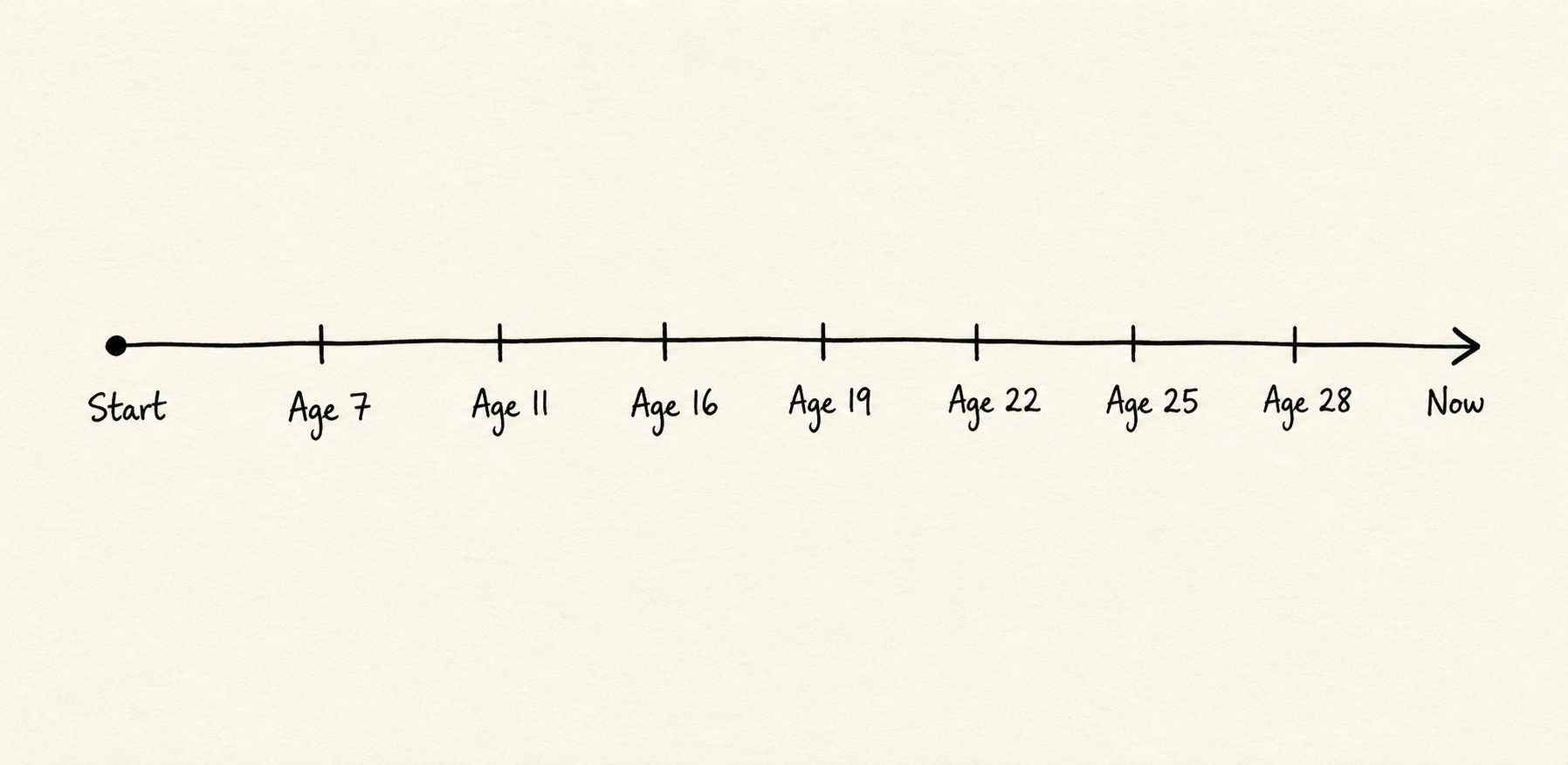
The full excavation: draw your life from birth to now, the way I did. Mark every courageous moment. Rate the intensity. Find the one that still lives most powerfully in your body. That is your key.
None of these require you to make sense of your life first. They only ask you to remember it.
From Survival Courage to Wisdom Courage
Here is what I didn't expect to find on my own line.
The early stops and the later ones weren't the same kind of courage, even though they looked similar from a distance.
The early acts were survival. Climbing out a window. Calling that company before the fear caught up with me. Driving to my mother at 3am. These weren't chosen so much as they were instinct — the body doing whatever it had to do to keep me alive, to keep me safe, to keep the people I loved from slipping away. That is real courage. It should never be diminished for being reflexive. But it is courage from fear, not courage toward something.
Somewhere along the line, the courage started to change shape. Choosing to parent differently. Surrendering control instead of gripping it. Moving to Bainbridge alone, against everyone's wishes, not because I was running from something but because I was finally choosing myself — while still, at the very same time, loving everyone I'd always loved. Not instead of them. Alongside them.
I said it into my phone on the forest walk, before I understood yet what it meant:
“As I choose myself, while I love others, it's feeling a little bit different than earlier in life, when it was just a survival savior mechanism.”
Survival courage keeps you alive. Wisdom courage lets you actually live. And if you draw your own line and look closely, you'll likely find the same current running through it — an early self who acted to survive, becoming a later self who acts because she finally trusts herself enough to choose.
Your Invitation
Here is what I'm inviting you to do with this second movement.
Sometime in the next day or two — find a piece of paper and ten quiet minutes. Draw a line. Birth on the left, today on the right. Mark every moment that required something of you. Don't edit. Don't rank them by how impressive they'd sound out loud. Just let them come.
What is the moment on my line that still lives in my body when I touch it?
That one is your well. You'll need it later.
You may not find it right away. That's alright. The asking matters as much as the answer. The turning toward is the practice.
If you'd like to sit with this again in your own ears rather than mine — the audio is above. Or pass it along to someone who's still waiting to feel ready. This is Movement 2. Not feeling ready is not a warning — it never was. Onward.
If something in this is stirring — that's the beginning. The courage was already there.
Listen to Movement 2 Audio →